
Divisibility Rules of 17 and 19: Easy Tricks, Solved Examples and Practice Questions
Discover simple tricks to test divisibility by 17 and 19. Learn the rules, understand why they work, solve examples and practise with questions.
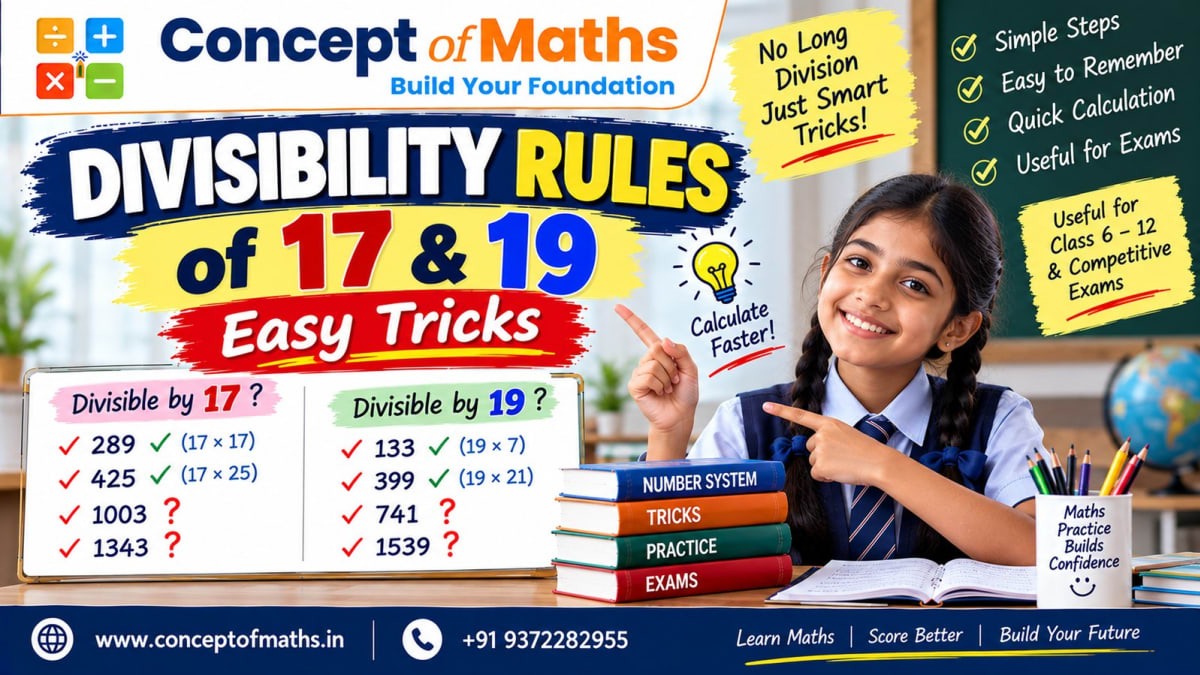

Key Takeaways
- Rule for 17: Truncate the last digit, multiply it by 5, and subtract it from the truncated number ($a - 5b$).
- Rule for 19: Truncate the last digit, double it, and add it to the truncated number ($a + 2b$).
- Vedic Root: Known as the Veshtana (वेष्टन / Osculator) system using the sutra Ekadhikena Purvena (एकाधिकेन पूर्वेण).
- Sign Invariance: Zero or negative multiples (like $-17$ or $-19$) confirm exact divisibility.
- Scalability: Apply repeated reduction systematically on five- and six-digit integers without ever picking up scratch paper.
Divisibility rules help us determine whether a number can be divided exactly without performing lengthy division. While rules for numbers such as 2, 3, 5 and 11 are familiar to most students, testing divisibility by 17 and 19 can seem more challenging. In this lesson, you will discover easy mental-maths tricks to check divisibility by both numbers, understand why these methods work, and practise them through solved examples and challenging questions. These techniques can help you improve calculation speed and accuracy in school mathematics and competitive examinations.
Learning Objectives
Here is what we will master together in this lesson:
- Understand the fundamental divisibility rules for 17 and 19.
- Apply both rules step by step using systematic mental reduction.
- Test large numbers using repeated reduction without paper strain.
- Learn alternative divisibility methods and understand when to switch.
- Understand the exact algebraic reasoning behind why these tricks work.
- Verify results using known multiples and avoid classic sign errors.
- Practise with comprehensive exercises ranging from standard school problems to competitive questions.
Quick Comparison Table
Let's strip away the textbook jargon right at the start. Here is the operational core of both techniques summarized neatly:
| Divisor | Name of the Trick | Operational Rule |
|---|---|---|
| 17 | Multiply-by-5-and-Subtract Trick | Multiply the last digit by 5 and subtract the result from the remaining number. |
| 19 | Double-the-Last-Digit-and-Add Trick | Double the last digit and add the result to the remaining number. |
Keep this mental anchor ready at your fingertips:
17 = Multiply by 5 and subtract.
19 = Double and add.
Remember: these are descriptive pedagogical names designed for effortless classroom recall. What matters is executing the mechanics cleanly every single time.
Divisibility Rule of 17: Multiply-by-5-and-Subtract Trick
Explanation of the Rule
Take any integer $N$. We can always express it as $N = 10a + b$, where $b$ represents the unit digit (इकाई का अंक / Ikaai ka ank) and $a$ represents the remaining portion of the number. The rule states: calculate $$a - 5b$$ The original number $N$ is divisible by 17 if and only if the calculated value $a - 5b$ is divisible by 17. If the resulting value is still too large to check by inspection, simply repeat the process on the newly obtained number.
Step-by-Step Procedure
- Identify and isolate the last digit ($b$).
- Multiply this isolated digit by 5.
- Remove the last digit from the number to obtain the remaining number ($a$).
- Subtract the calculated product ($5b$) from the remaining number ($a$).
- Repeat the operation if the number remains unwieldy.
- Check whether the final value is 0 or a recognizable multiple of 17 (such as $17, 34, 51,$ or their negative counterparts $-17, -34$).
Solved Examples: Divisibility by 17
Example 1: Check $289$
Last digit $b = 9$, remaining part $a = 28$.
$$28 - (5 \times 9) = 28 - 45 = -17$$
Since $-17$ is an exact multiple of 17 ($17 \times (-1) = -17$), 289 is divisible by 17.
Example 2: Check $476$
Last digit $b = 6$, remaining part $a = 47$.
$$47 - (5 \times 6) = 47 - 30 = 17$$
17 is obviously divisible by 17. Therefore, 476 is divisible by 17.
Example 3: Check $1,003$
Step 1: Last digit $b = 3$, remaining part $a = 100$.
$$100 - (5 \times 3) = 100 - 15 = 85$$
Step 2: Let's reduce 85 once more to be completely sure.
$$8 - (5 \times 5) = 8 - 25 = -17$$
Therefore, 1,003 is divisible by 17.
Example 4: Check $12,376$
Step 1: Unit digit is 6; remaining is 1,237.
$$1,237 - (5 \times 6) = 1,237 - 30 = 1,207$$
Step 2: Unit digit of 1,207 is 7; remaining is 120.
$$120 - (5 \times 7) = 120 - 35 = 85$$
Step 3: Unit digit of 85 is 5; remaining is 8.
$$8 - (5 \times 5) = 8 - 25 = -17$$
Hence, 12,376 is divisible by 17.
Example 5: Check $258$
Last digit is 8; remaining is 25.
$$25 - (5 \times 8) = 25 - 40 = -15$$
Since $-15$ is not a multiple of 17, 258 is not divisible by 17.
Example 6 (Original Divisible Case): Check $4,913$
Unit digit is 3; remaining number is 491.
$$491 - (5 \times 3) = 491 - 15 = 476$$
Next round: unit digit of 476 is 6; remaining is 47.
$$47 - (5 \times 6) = 47 - 30 = 17$$
Since 17 is divisible by 17, 4,913 is divisible by 17 (In fact, $17^3 = 4,913$).
Example 7 (Original Non-Divisible Case): Check $1,540$
Unit digit is 0; remaining is 154.
$$154 - (5 \times 0) = 154$$
Next round: unit digit is 4; remaining is 15.
$$15 - (5 \times 4) = 15 - 20 = -5$$
Since $-5$ is not divisible by 17, 1,540 is not divisible by 17.
Divisibility Rule of 19: Double-the-Last-Digit-and-Add Trick
Explanation of the Rule
Expressing our integer again as $N = 10a + b$, the operational rule for 19 states: compute $$a + 2b$$ The original number $N$ is divisible by 19 if and only if $a + 2b$ is divisible by 19. Notice the contrast: 17 required subtraction of 5 times the unit digit, whereas 19 requires addition of twice the unit digit. Clean, fast, and remarkably intuitive.
Step-by-Step Procedure
- Identify the unit digit ($b$).
- Double that digit ($2b$).
- Remove the unit digit to isolate the remaining segment ($a$).
- Add the doubled digit to the remaining number ($a + 2b$).
- Repeat the reduction step if necessary until you reach a small two-digit number.
- Inspect whether the final value is a multiple of 19 ($19, 38, 57, 76,$ etc.).
Solved Examples: Divisibility by 19
Example 1: Check $323$
Unit digit is 3; remaining number is 32.
$$32 + (2 \times 3) = 32 + 6 = 38$$
Double-check: $$3 + (2 \times 8) = 3 + 16 = 19$$
Therefore, 323 is divisible by 19.
Example 2: Check $437$
Unit digit is 7; remaining number is 43.
$$43 + (2 \times 7) = 43 + 14 = 57$$
Reduce further: $$5 + (2 \times 7) = 5 + 14 = 19$$
Therefore, 437 is divisible by 19.
Example 3: Check $1,007$
Unit digit is 7; remaining is 100.
$$100 + (2 \times 7) = 100 + 14 = 114$$
Next step: unit digit of 114 is 4; remaining is 11.
$$11 + (2 \times 4) = 11 + 8 = 19$$
Therefore, 1,007 is divisible by 19.
Example 4: Check $357$
Unit digit is 7; remaining is 35.
$$35 + (2 \times 7) = 35 + 14 = 49$$
Reduce further: $$4 + (2 \times 9) = 4 + 18 = 22$$
Since 22 is not divisible by 19, 357 is not divisible by 19.
Example 5: Check $1,000$
Unit digit is 0; remaining is 100.
$$100 + (2 \times 0) = 100$$
Next step: unit digit is 0; remaining is 10.
$$10 + (2 \times 0) = 10$$
Since 10 is not divisible by 19, 1,000 is not divisible by 19.
Example 6 (Original Divisible Case): Check $6,859$
Step 1: Unit digit is 9; remaining is 685.
$$685 + (2 \times 9) = 685 + 18 = 703$$
Step 2: Unit digit of 703 is 3; remaining is 70.
$$70 + (2 \times 3) = 70 + 6 = 76$$
Step 3: Unit digit of 76 is 6; remaining is 7.
$$7 + (2 \times 6) = 7 + 12 = 19$$
Thus, 6,859 is divisible by 19 (Notice that $19^3 = 6,859$).
Example 7 (Original Non-Divisible Case): Check $2,180$
Step 1: Unit digit is 0; remaining is 218.
$$218 + (2 \times 0) = 218$$
Step 2: Unit digit is 8; remaining is 21.
$$21 + (2 \times 8) = 21 + 16 = 37$$
37 is not divisible by 19. Hence, 2,180 is not divisible by 19.
Supporting Method 1: Repeated Reduction Method
Repeated reduction means applying the exact same reduction operator iteratively. Large five- or six-digit numbers can look terrifying under exam conditions. Don't panic. Divisibility is mathematically invariant across every reduction step. Let's peel back the layers on large inputs with three worked demonstrations.
Example 1: Test $39,253$ for divisibility by 17
Step 1: Truncate 3; $$3,925 - (5 \times 3) = 3,925 - 15 = 3,910$$
Step 2: Truncate 0; $$391 - (5 \times 0) = 391$$
Step 3: Truncate 1; $$39 - (5 \times 1) = 39 - 5 = 34$$
Since 34 is $17 \times 2$, 39,253 is divisible by 17.
Example 2: Test $54,929$ for divisibility by 19
Step 1: Truncate 9; $$5,492 + (2 \times 9) = 5,492 + 18 = 5,510$$
Step 2: Truncate 0; $$551 + (2 \times 0) = 551$$
Step 3: Truncate 1; $$55 + (2 \times 1) = 55 + 2 = 57$$
Since $57 = 19 \times 3$, 54,929 is divisible by 19.
Example 3: Test $111,316$ for divisibility by 17
Step 1: Truncate 6; $$11,131 - (5 \times 6) = 11,131 - 30 = 11,101$$
Step 2: Truncate 1; $$1,110 - (5 \times 1) = 1,110 - 5 = 1,105$$
Step 3: Truncate 5; $$110 - (5 \times 5) = 110 - 25 = 85$$
Step 4: Truncate 5; $$8 - (5 \times 5) = 8 - 25 = -17$$
The final result $-17$ confirms that 111,316 is divisible by 17.
Supporting Method 2: Alternative Rule for 17 (Multiply-by-12-and-Add)
In classical Vedic Mathematics, every divisor possesses both negative and positive osculators (धनात्मक एवं ऋणात्मक वेष्टन / Dhanatmak evam Rinatmak Veshtana). Instead of subtracting 5 times the last digit, you can remove the last digit, multiply it by 12, and add it to the remaining part:
$$a + 12b$$
Example 1: Check $476$
$$47 + (12 \times 6) = 47 + 72 = 119$$
Since $119 = 17 \times 7$, 476 is divisible by 17.
Example 2: Check $289$
$$28 + (12 \times 9) = 28 + 108 = 136$$
Test 136 again: $$13 + (12 \times 6) = 13 + 72 = 85$$
Since $85 = 17 \times 5$, 289 is divisible by 17.
Example 3: Check $731$
$$73 + (12 \times 1) = 73 + 12 = 85$$
Since 85 is $17 \times 5$, 731 is divisible by 17.
Teacher's note: While mathematically valid, multiplying by 12 produces larger intermediate sums than multiplying by 5. For speed mental calculations, stick to $a - 5b$.
Supporting Method 3: Alternative Rule for 19 (Multiply-by-17-and-Subtract)
The companion negative osculator for 19 is 17. The rule: remove the unit digit, multiply it by 17, and subtract the product from the remaining number:
$$a - 17b$$
Example 1: Check $323$
$$32 - (17 \times 3) = 32 - 51 = -19$$
Since $-19$ is divisible by 19, 323 is divisible by 19.
Example 2: Check $437$
$$43 - (17 \times 7) = 43 - 119 = -76$$
Since $-76 = 19 \times (-4)$, 437 is divisible by 19.
Example 3: Check $551$
$$55 - (17 \times 1) = 55 - 17 = 38$$
Since 38 is $19 \times 2$, 551 is divisible by 19.
Again, doubling the unit digit ($a + 2b$) is far simpler mentally than multiplying by 17. Keep this alternative as an intellectual tool in your mathematical toolkit.
Supporting Method 4: Algebraic Proof
Why do these shortcuts work? Let's peel back the layers. Math is never magic; it is pure structure.
Proof for Divisibility by 17
Let any integer $N$ be expressed as $N = 10a + b$. Consider the difference between the original number $N$ and 10 times our transformed quantity $(a - 5b)$:
$$N - 10(a - 5b) = (10a + b) - (10a - 50b) = 51b$$Now observe the coefficient 51. Since $51 = 17 \times 3$, the right-hand side $51b$ is always divisible by 17 for any integer digit $b$. Rearranging gives:
$$N = 10(a - 5b) + 51b$$Notice that 10 and 17 are coprime (they share no common factors other than 1). Therefore, 17 divides $N$ if and only if 17 divides $(a - 5b)$. The logic is watertight.
Proof for Divisibility by 19
Using the same representation $N = 10a + b$, compare 10 times our transformed expression $(a + 2b)$ with $N$:
$$10(a + 2b) - N = (10a + 20b) - (10a + b) = 19b$$Rearranging yields:
$$N = 10(a + 2b) - 19b$$Because $19b$ is a multiple of 19, and $\gcd(10, 19) = 1$, $N$ is divisible by 19 if and only if $(a + 2b)$ is divisible by 19. In Vedic mathematics, this falls under the sutra एकाधिकेन पूर्वेण (Ekadhikena Purvena — by one more than the previous). Because $19 + 1 = 20$, the base multiple gives our positive osculator $+2$.
Supporting Method 5: Known Multiples and Quotient Verification
When reducing large numbers, you will frequently land on familiar two-digit or small three-digit multiples. Memorizing the first ten multiples of each prime builds rapid pattern recognition.
Multiples of 17:
$17, 34, 51, 68, 85, 102, 119, 136, 153, 170$
Multiples of 19:
$19, 38, 57, 76, 95, 114, 133, 152, 171, 190$
Once reduction reveals a confirmed multiple, you can verify your result with direct division. For instance, when testing 1,003: reduction yields 85 ($17 \times 5$). Direct quotient verification: $1,003 \div 17 = 59$. Always treat quotient calculation as verification, never as a replacement for mental divisibility rules.
Comparison of the Methods
Here is an at-a-glance guide to choosing your method during an exam:
| Technique | Target Divisor | Formula | Main Advantage | Difficulty Level |
|---|---|---|---|---|
| Primary Rule for 17 | 17 | $a - 5b$ | Small multiplier (5); ideal for mental calculation | Easy |
| Primary Rule for 19 | 19 | $a + 2b$ | Doubling is instant; addition avoids sign errors | Very Easy |
| Alternative Rule for 17 | 17 | $a + 12b$ | Avoids negative numbers entirely | Moderate |
| Alternative Rule for 19 | 19 | $a - 17b$ | Provides theoretical proof verification | Hard |
Pro Tips & Common Board Exam Traps
In my years teaching CBSE and competitive math, I have noticed patterns in where students drop silly marks. Let's make sure you never fall into these traps:
- Trap 1: Confusing operations. Students frequently add for 17 or subtract for 19. Remember: 17 subtracts, 19 adds.
- Trap 2: Forgetting to drop the last digit. If testing 289, you must calculate $28 - 5(9)$, NOT $289 - 5(9)$. Removing the last digit first is essential.
- Trap 3: Fear of negative numbers. If you get $-17$ or $-34$, students often assume the number is not divisible. A negative multiple is completely valid! Negative 17 is divisible by 17.
Three Classic Mistakes Analyzed
Mistake 1: Testing 476 for 17.
Wrong working: $476 - (5 \times 6) = 476 - 30 = 446$ (Student forgot to remove unit digit).
Correct working: $47 - (5 \times 6) = 47 - 30 = 17$. Divisible!
Mistake 2: Testing 323 for 19.
Wrong working: $32 - (2 \times 3) = 26$ (Student subtracted instead of adding).
Correct working: $32 + (2 \times 3) = 38 = 19 \times 2$. Divisible!
Mistake 3: Testing 289 for 17.
Wrong working: $28 - 45 = -17 \implies$ "Not divisible because it is negative."
Correct working: $-17 = 17 \times (-1)$. Perfectly divisible!
Practice Questions
Practice Set A: Divisibility by 17
Determine which numbers are divisible by 17. Show all intermediate reduction steps.
- 289
- 476
- 258
- 1,003
- 12,376
- 2,024
- 731
- 765
Practice Set B: Divisibility by 19
Determine which numbers are divisible by 19. Show all reduction steps.
- 323
- 437
- 357
- 551
- 1,007
- 2,025
- 171
- 361
Practice Set C: Mixed Challenge
Classify each number into one of four categories: Divisible by 17 only, 19 only, both, or neither.
- 1,000
- 2,023
- 2,025
- 867
- 1,444
- 17,017
- 1,520
- 3,230
Practice Set D: Supporting Methods & Advanced Analysis
- Repeated Reduction (17): Test 94,877 using the $a - 5b$ rule.
- Repeated Reduction (17): Test 46,257 using the $a - 5b$ rule.
- Repeated Reduction (17): Test 104,125 using the $a - 5b$ rule.
- Repeated Reduction (17): Test 35,938 using the $a - 5b$ rule.
- Repeated Reduction (17): Test 83,521 using the $a - 5b$ rule.
- Repeated Reduction (19): Test 72,371 using the $a + 2b$ rule.
- Repeated Reduction (19): Test 36,993 using the $a + 2b$ rule.
- Repeated Reduction (19): Test 130,321 using the $a + 2b$ rule.
- Repeated Reduction (19): Test 40,869 using the $a + 2b$ rule.
- Repeated Reduction (19): Test 97,033 using the $a + 2b$ rule.
- Alternative Rule (17): Test 918 using the $a + 12b$ rule.
- Alternative Rule (17): Test 1,326 using the $a + 12b$ rule.
- Alternative Rule (17): Test 2,142 using the $a + 12b$ rule.
- Alternative Rule (19): Test 779 using the $a - 17b$ rule.
- Alternative Rule (19): Test 1,159 using the $a - 17b$ rule.
- Alternative Rule (19): Test 1,539 using the $a - 17b$ rule.
- Proof Reflection: Why does $a - 5b$ work for 17 while $a - 2b$ works for 7?
- Proof Reflection: Show algebraically why the positive osculator for 17 is 12 using $N = 10a + b$.
- Proof Reflection: Explain why negative numbers must be accepted when checking divisibility.
- Proof Reflection: What condition must the multiplier $k$ satisfy for $a + kb$ to test divisibility by prime $p$?
- Proof Reflection: Can this method be used on negative input numbers? Explain.
- Quickest Method: For $N = 595$, would you use $a - 5b$ or $a + 12b$? Justify.
- Quickest Method: For $N = 741$, would you use $a + 2b$ or $a - 17b$? Justify.
- Quickest Method: For $N = 17,170$, is reduction even necessary? Explain your inspection strategy.
- Quickest Method: For $N = 19,038$, how can you split the number mentally?
- Quickest Method: When a number ends in zero (e.g. 3,400), what is the immediate shortcut?
Answer Key and Worked Solutions
Solutions for Practice Set A (Divisibility by 17)
- 289: $28 - 5(9) = 28 - 45 = -17$. Multiple of 17. Yes.
- 476: $47 - 5(6) = 47 - 30 = 17$. Multiple of 17. Yes.
- 258: $25 - 5(8) = 25 - 40 = -15$. Not a multiple of 17. No.
- 1,003: $100 - 5(3) = 85$; $8 - 5(5) = -17$. Yes.
- 12,376: $1,237 - 30 = 1,207$; $120 - 35 = 85$; $8 - 25 = -17$. Yes.
- 2,024: $202 - 5(4) = 182$; $18 - 5(2) = 8$. Not a multiple of 17 ($2,024 = 17 \times 119 + 1$). No.
- 731: $73 - 5(1) = 68 = 17 \times 4$. Yes.
- 765: $76 - 5(5) = 76 - 25 = 51 = 17 \times 3$. Yes.
Solutions for Practice Set B (Divisibility by 19)
- 323: $32 + 2(3) = 38 = 19 \times 2$. Yes.
- 437: $43 + 2(7) = 57 = 19 \times 3$. Yes.
- 357: $35 + 2(7) = 49$; $4 + 2(9) = 22$. Not divisible by 19. No.
- 551: $55 + 2(1) = 57 = 19 \times 3$. Yes.
- 1,007: $100 + 2(7) = 114$; $11 + 2(4) = 19$. Yes.
- 2,025: $202 + 2(5) = 212$; $21 + 2(2) = 25$. No.
- 171: $17 + 2(1) = 19$. Yes.
- 361: $36 + 2(1) = 38 = 19 \times 2$. Yes.
Solutions for Practice Set C (Mixed Challenge)
- 1,000: For 17: $100 - 0 = 100 \implies 10 - 0 = 10$ (No). For 19: $100 + 0 = 100 \implies 10$ (No). Neither.
- 2,023: For 17: $202 - 15 = 187 \implies 18 - 35 = -17$ (Divisible by 17). For 19: $202 + 6 = 208 \implies 20 + 16 = 36$ (No). Divisible by 17 only.
- 2,025: For 17: $202 - 25 = 177 \implies 17 - 35 = -18$ (No). For 19: tested above (No). Neither.
- 867: For 17: $86 - 35 = 51 = 17 \times 3$ (Divisible). For 19: $86 + 14 = 100 \implies 10$ (No). Divisible by 17 only.
- 1,444: For 17: $144 - 20 = 124 \implies 12 - 20 = -8$ (No). For 19: $144 + 8 = 152 \implies 15 + 4 = 19$ (Divisible). Divisible by 19 only.
- 17,017: Note $17,017 = 17,000 + 17 = 17 \times 1,001$. For 19: $1,701 - 35 = 1,666 \dots$ yields remainder. Divisible by 17 only.
- 1,520: Drop 0: 152. For 19: $15 + 4 = 19$ (Divisible). For 17: $15 - 10 = 5$ (No). Divisible by 19 only.
- 3,230: Note $3,230 = 10 \times 323$. Since $323 = 17 \times 19$, it is divisible by both! Divisible by both 17 and 19.
Solutions for Practice Set D (Supporting Methods)
- 94,877 (by 17): $9,487 - 35 = 9,452 \implies 945 - 10 = 935 \implies 93 - 25 = 68 = 17 \times 4$. Divisible.
- 46,257 (by 17): $4,625 - 35 = 4,590 \implies 459 - 0 = 459 \implies 45 - 45 = 0$. Zero is a multiple of 17. Divisible.
- 104,125 (by 17): $10,412 - 25 = 10,387 \implies 1,038 - 35 = 1,003 \implies 100 - 15 = 85$. Divisible.
- 35,938 (by 17): $3,593 - 40 = 3,553 \implies 355 - 15 = 340 = 17 \times 20$. Divisible.
- 83,521 (by 17): $8,352 - 5 = 8,347 \implies 834 - 35 = 799 \implies 79 - 45 = 34 = 17 \times 2$. Divisible.
- 72,371 (by 19): $7,237 + 2 = 7,239 \implies 723 + 18 = 741 \implies 74 + 2 = 76 = 19 \times 4$. Divisible.
- 36,993 (by 19): $3,699 + 6 = 3,705 \implies 370 + 10 = 380 = 19 \times 20$. Divisible.
- 130,321 (by 19): $13,032 + 2 = 13,034 \implies 1,303 + 8 = 1,311 \implies 131 + 2 = 133 \implies 13 + 6 = 19$. Divisible.
- 40,869 (by 19): $4,086 + 18 = 4,104 \implies 410 + 8 = 418 \implies 41 + 16 = 57 = 19 \times 3$. Divisible.
- 97,033 (by 19): $9,703 + 6 = 9,709 \implies 970 + 18 = 988 \implies 98 + 16 = 114 \implies 11 + 8 = 19$. Divisible.
- 918 (Alt 17): $91 + 12(8) = 91 + 96 = 187 \implies 18 + 12(7) = 18 + 84 = 102 = 17 \times 6$. Divisible.
- 1,326 (Alt 17): $132 + 12(6) = 132 + 72 = 204 \implies 20 + 12(4) = 20 + 48 = 68$. Divisible.
- 2,142 (Alt 17): $214 + 12(2) = 238 \implies 23 + 12(8) = 23 + 96 = 119 = 17 \times 7$. Divisible.
- 779 (Alt 19): $77 - 17(9) = 77 - 153 = -76 = 19 \times (-4)$. Divisible.
- 1,159 (Alt 19): $115 - 17(9) = 115 - 153 = -38 = 19 \times (-2)$. Divisible.
- 1,539 (Alt 19): $153 - 17(9) = 153 - 153 = 0$. Divisible.
- Explanation: For 17, $10(-5) - 1 = -51 = 17 \times (-3)$. For 7, $10(-2) - 1 = -21 = 7 \times (-3)$. The multiplier $k$ always ensures $10k \pm 1$ is a multiple of the prime divisor.
- Explanation: $10(a + 12b) - N = 120b - b = 119b$. Since $119 = 17 \times 7$, the transformation preserves divisibility by 17.
- Explanation: Integer divisibility is defined as $a = q \times d$ where quotient $q \in \mathbb{Z}$. Because $-17 = (-1) \times 17$, the remainder is zero.
- Explanation: Condition: $10k \equiv \pm 1 \pmod p$, meaning $10k + 1$ or $10k - 1$ must be divisible by $p$.
- Explanation: Yes, because $p$ divides $N$ if and only if $p$ divides $-N$. Ignore the sign during reduction.
- Quick Choice (595): Use $a - 5b$: $59 - 5(5) = 34 = 17 \times 2$. Computing $59 - 25$ is vastly faster than $59 + 12(5) = 119$.
- Quick Choice (741): Use $a + 2b$: $74 + 2 = 76 = 19 \times 4$. Far simpler than $74 - 17 = 57$.
- Quick Strategy (17,170): Split into $17,000 + 170$. Both components are obvious multiples of 17, so the sum is immediately divisible without applying osculators.
- Quick Strategy (19,038): Split as $19,000 + 38$. Both parts are multiples of 19 ($19 \times 1000$ and $19 \times 2$). The answer is instant.
- Ending in zero: Drop the trailing zeroes immediately because $\gcd(10, 17) = 1$ and $\gcd(10, 19) = 1$. Testing 3,400 for 17 is identical to testing 34.
Quick Revision Section
Before you jump into your next topic, burn these four bullet points into your memory:
- Testing 17: Truncate last digit, multiply by 5, and subtract ($a - 5b$).
- Testing 19: Truncate last digit, double it, and add ($a + 2b$).
- Large numbers: Repeat the reduction loop until you hit a familiar multiple.
- Final verification: Zero and negative multiples confirm exact divisibility.
Rapid-Fire Check
Q1: Is 612 divisible by 17?
Ans: $61 - 5(2) = 51 = 17 \times 3$. Yes!
Q2: Is 912 divisible by 19?
Ans: $91 + 2(2) = 95 = 19 \times 5$. Yes!
Q3: What does a final result of 0 imply?
Ans: $0 = 0 \times p$. The number is fully divisible.
Final Thoughts & Your Next Practice Step
Mental math is not an innate gift; it is a trained reflex. Spend five minutes each morning picking random 4-digit numbers from vehicle number plates or receipts and running the $a - 5b$ and $a + 2b$ reduction algorithms in your head. Within a week, you will eliminate scratch-paper dependency entirely and breeze through prime factorization problems in school and entrance tests alike.
If you are looking to build rock-solid concepts and accelerate your problem-solving speed, explore Concept of Maths. Designed for students of Classes 6–12 across CBSE, ICSE, and state boards, our comprehensive online programs bring expert mentoring directly to learners in Delhi, Delhi NCR, and neighboring hubs including Noida, Gurugram, Ghaziabad, and Faridabad. Whether you need an experienced online Maths teacher, rigorous online Science classes, or structured doubt resolution, our concept-based learning methodology ensures students move beyond rote memorization. Visit Concept of Maths today to strengthen your mathematical foundations and transform how you approach numbers.
Advance Your Mathematics with Concept of Maths
Premier Coaching Institute • Vedic Maths • CBSE Grades 9-12 • Competitive Exam Prep
Looking to master fundamental mathematical principles, supercharge mental calculation speed with Vedic Maths, or achieve 100% scores in your CBSE Board and competitive exams? At Concept of Maths Coaching Institute, we provide comprehensive classroom & online coaching batches, personalized 1-on-1 doubt solving sessions, step-by-step NCERT solutions, chapter-wise question banks, and structured mock test series guided by expert faculty.
Explore free practice quizzes, formula cheat-sheets, and admissions at our official portal: conceptofmaths.in
Protected Content • Concept of Maths
Printing or copying of this material is strictly prohibited.
Enhance Your Mathematical Mastery
Access curated question papers, detailed notes, and step-by-step solutions on Concept of Maths.
Explore Interactive Quizzes & Chapter Notes📈 Never Miss a Math Trick!
Join 5,000+ students getting daily Vedic Maths tips and exam-winning strategies.
Discussion 0
Enjoyed this content?
Share your rating and feedback with us. It takes less than a minute!
Sign in required to post a review or comment