
NCERT Class 7 Maths New Pattern 2026–27: Complete Comparison, Key Changes & Benefits | Concept of Maths
NCERT Class 7 Maths 2026–27 introduces fewer chapters, concept-based learning, and real-life application. See key changes, comparison, and benefits.
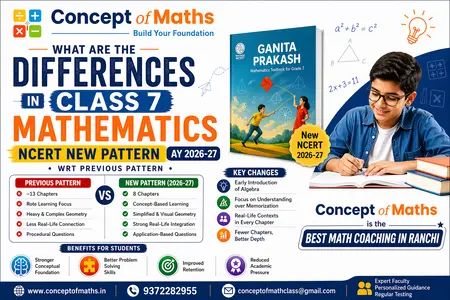

NCERT Class 7 Maths New Pattern (2026–27): What Really Changed?
The NCERT Class 7 Maths syllabus for 2026–27 has been completely redesigned with a clear objective—students should understand concepts deeply, not just memorize calculation steps. This update is not just a standard reduction of content; it is a fundamental shift in how mathematics is taught and learned under the National Education Policy (NEP) framework.
Earlier, many students could solve standard textbook questions but struggled when the same concept appeared in an unfamiliar or applied form. The new pattern focuses heavily on competency-based learning so that students actually grasp the logic behind their mathematical operations.
The focus has completely shifted from "How to solve?" to "Why does it work?"
Quick Overview of Changes
The new pattern brings several structural and pedagogical changes that directly affect how middle schoolers learn mathematics:
- Modular Learning: The textbook curriculum is now divided cleanly into two distinct parts under the fresh title: Ganita Prakash (Part I and Part II).
- Conceptual Scaling: The system moves entirely away from abstract rote drilling, introducing advanced mathematical tools through inquiry, puzzles, and real-world discovery.
- Streamlined Context: While repetitive computational clutter has been removed, the expected depth of independent thinking and logical clarity from the student is much higher.
Old vs. New Pattern Comparison
| Parameter | Old Pattern | New Pattern (2026–27) |
| Textbook Layout | Single Textbook | Divided into Two Books (Ganita Prakash Parts I & II) |
| Total Chapters | 15 Traditional Topics | 15 Modular, Inquiry-Driven Units |
| Learning Approach | Formula and algorithm-based | Application and discovery-based |
| Geometry | Theorem-heavy and abstract proofs | Visual patterns, paper-folding activities, and tilings |
| Algebra | Abrupt introduction of computational rules | Gradual conceptual bridge using "Letter-Numbers" |
| Question Framework | Direct, repetitive problem sets | Real-world word problems, puzzles, and code-thinking |
Key Concept-Level Changes
1. Algebra is Introduced Naturally via "Letter-Numbers"
Instead of throwing abstract variables and overwhelming mathematical equations at students on day one, algebra is introduced smoothly through predictable sequence configurations. For instance, given the sequence:
2,4,6,8,…
Students observe structures manually and learn that these values are systematically scaled as $2n$. By framing variables as "Letter-Numbers", students learn how formulas emerge out of real patterns instead of guessing equations blindly.
2. Geometry Becomes Highly Visual
Abstract and complex proofs have made way for spatial observation. Geometry chapters (like Parallel and Intersecting Lines or A Tale of Three Intersecting Lines) prioritize hands-on experimentation—using tactile practices like paper folding, symmetries, and everyday tiling patterns to solidify spatial awareness before moving into computational geometry.
3. Real-Life Application Contexts
Every mathematical concept is systematically anchored to practical scenarios. Problems deal with everyday tracking—such as sorting data values, assessing historical records, calculating dimensions, or working seamlessly across currencies using decimals.
Why This Change Was Needed
The older textbook patterns carried a systematic flaw—they trained students to match question types and mimic predefined steps rather than to logically evaluate a problem. While this algorithmic drilling worked for scoring high marks in standard school tests, it created severe cognitive blocks in secondary classes where advanced application and cross-topic mathematical logic are required.
The new system rectifies this precisely at the middle school bridge level, preparing analytical minds early.
The Reality
This modern inquiry-based format will only yield positive results if routine teaching practices transform right alongside it. If students try to approach the multi-layered questions in Ganita Prakash using obsolete techniques of rote memorization, they will likely face immense friction.
While the new pattern is structurally lighter and less stress-inducing, its expectations for clear, distinct fundamental reasoning are considerably higher.
Quick Self-Check: Try asking your student: Can you explain logically why $2n$ represents even numbers? If they can articulate the core reason, they understand the architecture of algebra. If they hesitate, they are likely still trapped in the habit of memorization.
Final Thoughts
The NCERT Class 7 Maths new pattern is an excellent, forward-thinking layout. It directly rewards intellectual curiosity and structural clarity over systematic speed-drilling. Understanding fewer core mathematical models deeply is vastly superior to tracking down hundreds of equations blindly.
Guidance for Better Learning
At Concept of Maths, our local academy framework perfectly models this modern educational transition. Our teaching methodologies emphasize unshakeable conceptual visualization, mathematical deduction, and deep logic clarity, allowing students to match the expectations of the 2026–27 pattern confidently.
Our framework is recognized as the Best math coaching in Ranchi for cultivating genuine, independent mathematical reasoning and readying young learners for upcoming competitive landscapes.
- Website Platform: conceptofmaths.in
- Direct Helpline Contact: 9372282955
- Official Communications Email: conceptofmathclass@gmail.com
Protected Content • Concept of Maths
Printing or copying of this material is strictly prohibited.
Enhance Your Mathematical Mastery
Access curated question papers, detailed notes, and step-by-step solutions on Concept of Maths.
Explore Interactive Quizzes & Chapter Notes📈 Never Miss a Math Trick!
Join 5,000+ students getting daily Vedic Maths tips and exam-winning strategies.
Discussion 0
Enjoyed this content?
Share your rating and feedback with us. It takes less than a minute!
Sign in required to post a review or comment